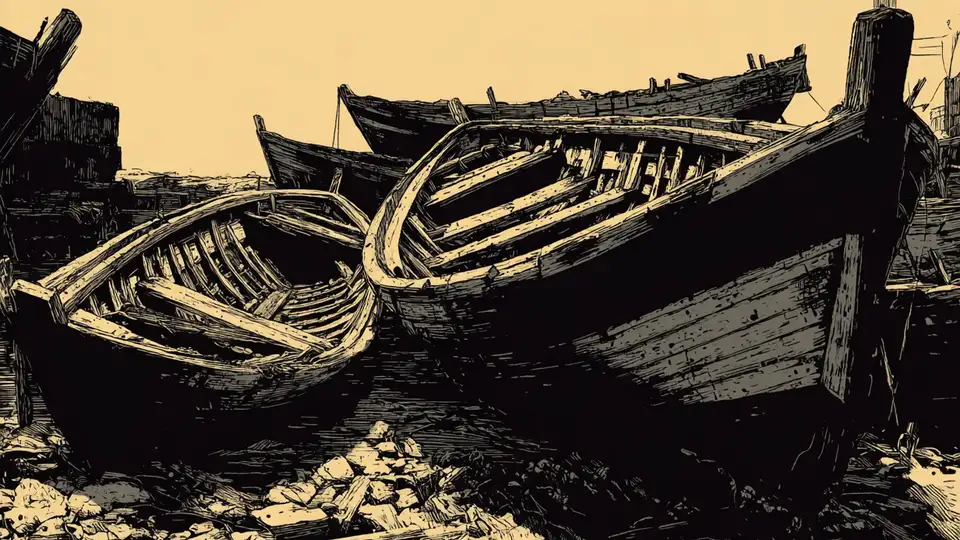
Recent United States aerial bombardments across southern Iranian provinces have severely damaged civilian infrastructure and livelihoods. Fishermen in Bandar Abbas lost hundreds of wooden vessels to harbor strikes, while communication towers, bridges, power plants, and transportation routes sustained heavy destruction. Furthermore, missile blasts near an Ahvaz pediatric hospital forced the emergency evacuation of two hundred eleven young patients.
**YANKEE BIRDS RAIN STEEL ON PERSIAN SOUTHERN COAST; FISHERMEN’S BOATS SMASHED TO TINDER IN BRUTAL AERIAL ONSLAUGHT**
**AHVAZ, Persia**—When the iron thunderbolts of the American flying machines fell upon the bustling harbor of Bandar Abbas last month, fifty-six-year-old Sajjad watched his very livelihood go up in billowing clouds of greasy black smoke.
The small timber skiff that had sustained Sajjad and his kin for long, weary years was beaten into a charred skeleton, joining scores of fellow craft littering the quays. Sajjad, speaking to our correspondents, laments that scarce a fisherman in his acquaintance escaped the nocturnal visitation with a whole vessel. To procure a single new craft requires two billion tomans—a king’s ransom of some one thousand and fifty gold dollars—putting it far beyond the purse of any honest working family.
“Both my chicks are striving at the university,” a grief-stricken Sajjad declared. “My all depended upon that little boat. Soon, I shall be cast low, unable even to clear their school-bills.”
When the Yankee bombardment flared anew at the dawn of July following a brief respite, the tempest fell with crushing weight upon the sultry southern provinces. Dispatches from Khuzestan, Hormozgan, Sistan, and Baluchestan paint a grim tableau of a campaign that spares neither barracks nor breadbasket, smashing fishing ports, lofty spans, whispering telegraph wires, powerhouse dynamos, healing dispensaries, and the arteries of trade.
Dozens of sky-scraping wireless towers have been battered into silence, paralyzing the telegraph and the telephone. A ferocious blow near Tappeh Aluakbar, just outside Bandar Abbas, snuffed out five souls, among them a heroic mother who spent her dying breath shielding her babe with her own mortal frame.
The highways and iron roads have suffered a like ruin. Alireza, a Hormozgan lad studying the cinematograph arts who chronicles the devastation for a projected moving-picture chronicle, ticked off a melancholy ledger of destruction: the heights of Tappeh Aluakbar, the spans bridging Bandar Abbas to Khamir and Rudan, the railway iron, and the vital turnpikes of the region. So desperate was the plight at one shattered crossing that road-gangs hastily carved a crude wagon-track through a bone-dry riverbed within the tick of a clock merely to keep the wheels of commerce turning.
Upon the brine, the ruin is absolute. Alireza computes that nigh upon three hundred humble fishing boats have been sent to Davy Jones’s locker across Bandar Abbas, Bandar Lengeh, Sirik, and Jask, ruining the