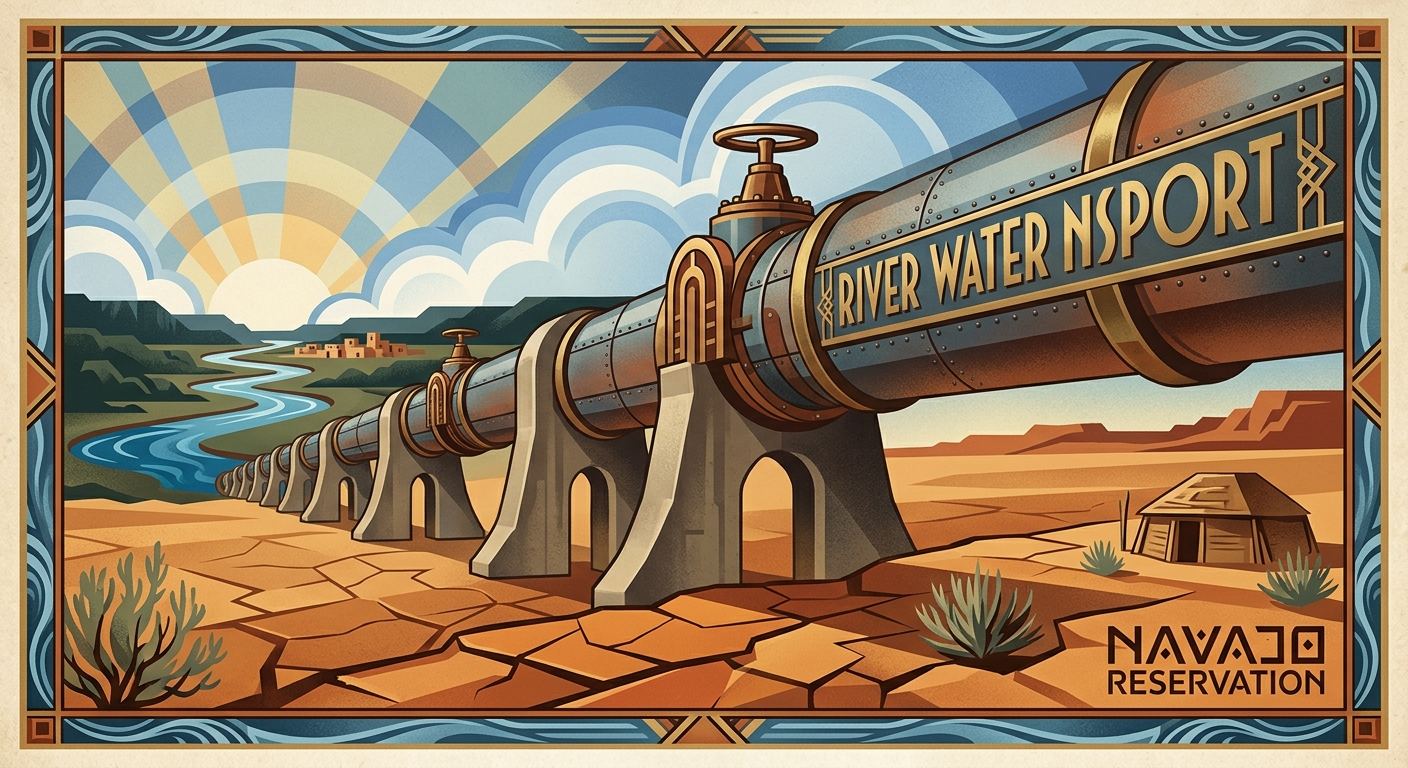
In the landmark 1950s Supreme Court case Arizona v. California, the U.S. government bowed to political pressure from Western states and watered down its defense of Native American tribes' water rights to the Colorado River. This historical failure left major tribes like the Navajo Nation without secured water rights, establishing a pattern of state opposition and federal neglect that persists today. This ongoing exclusion matters because it denies clean, reliable water access to thousands of Native American residents living on reservations amidst a worsening climate crisis.
**THE DAILY INQUIRER**
*The Paper for the Thinking Citizen*
**EXTRA EDITION**
---
### **THE GREAT COLORADO WATER ROBBERY!**
#### **Uncle Sam Sells First Americans Down the River in Sensational Backroom Double-Cross!**
#### **DESERT BARONS PLOT TO DRY UP RESERVATIONS WHILE CITIES GUZZLE LIQUID GOLD!**
***
**By a Special Correspondent**
**WASHINGTON, D.C.** — It is a tale of high-stakes gambling, political chicanery, and a cold-blooded double-cross that would make a Chicago racketeer blush!
For decades, the sun-baked states of Arizona and California have been locked in a vicious, bare-knuckle brawl over the Colorado River—each clawing for every drop of liquid gold to fuel their roaring postwar booms. But while these two heavyweight slickers traded blows in the highest court in the land, a silent third party was quietly, systematically fleeced of their birthright.
Newly unearthed secret documents, dragged into the light of day by a sharp-eyed history professor from the University of Virginia, Christian McMillen, reveal a shocking paper trail of perfidy. The files prove what the fat cats in Phoenix and Los Angeles have denied for seventy years: **The fix was in!**
---
### **THE WARNING ON THE WALL**
Back in the year of our Lord 1953, as the federal lawyers prepared to enter the legal ring on behalf of the tribes, one sharp-eyed government counselor saw the writing on the wall. Special Assistant Attorney General T.F. Neighbors penned a desperate memo warning the big wigs in Washington that if Uncle Sam didn't stand up for the tribes’ water rights immediately, the states would drink the river dry.
**“When an economy has grown up premised upon the use of Indian waters,”** Neighbors warned in cold, hard print, **“the Indians are confronted with the virtual impossibility of having awarded to them the waters of which they had been illegally deprived.”**
But his plea fell on deaf ears.
As the years dragged on like a slow train through the desert, the Navajo Nation—the largest tribe in the territory—watched their hopes evaporate. By 1961, tribal counselor Norman Littell sent a blistering, red-hot missive to Attorney General Robert F. Kennedy himself. If the Navajos were left high and dry, Littell warned, it would spell absolute doom for the reservation, crushing any hope of future prosperity intended by Congress.
Both men were prophets of the highest order. But their warnings were buried deep in the archives, while the desert barons laughed all the way to the bank.
---
### **SMOKE-FILLED ROOMS AND THE THREE MISSING WORDS**
How did this grand larceny happen right under the nose of Uncle Sam?
The records tell a story of political muscle and backroom spinelessness. In November of 1953, Attorney General Herbert Brownell Jr. actually showed some backbone, filing a petition in court declaring that tribal water rights were **“prior and superior”** to all others.
The Western politicians went absolutely apoplectic!
Arizona Governor John Howard Pyle hopped the first train to Washington to corner the Attorney General. Under immense political heat, Brownell folded like a cheap suit. Just four days after filing the document, the Department of Justice yanked it back. When they refiled a month later, those three mighty words—**“prior and superior”**—had been completely erased.
**“Politics smothered the rights of the Indians,”** one disgusted government attorney wrote in the aftermath.
---
### **“INDIAN RAIDS!” — THE SMEAR CAMPAIGN EXPOSED**
While the states shook hands behind closed doors, their agents waged a ruthless public relations war. In 1956, J.A. Riggins Jr., a slick mouthpiece for the Salt River Project (a massive non-tribal utility supplying Phoenix), took to the podium at a water users’ conference to sound a hysterical alarm.
In a speech titled **“The Indian threat to our water rights,”** Riggins warned of mythical **“Indian raids”** on white water supplies, urging the crowd to protect their territories from the tribal menace.
At the very same time, Arizona’s legal eagles were drafting a slick agreement to freeze the tribes out of court entirely, promising to "protect" their rights later—a classic shell game that other states eagerly signed onto.
---
### **THE SUPREME COURT SHUTS THE DOOR**
When the Supreme Court finally handed down its landmark decree in 1964, California, Arizona, and Nevada walked away with their pockets full of water. Five small tribes along the riverbanks got a few crumbs. But the great Navajo Nation, whose reservation sprawls across three states, was left out in the cold entirely.
Decades have passed, and the song remains the same. Millions of new settlers have poured into Arizona, turning dusty outposts into sprawling, thirsty metropolises.
Meanwhile, on the Navajo Reservation, the taps are dry. This past June, the Supreme Court—in the case of *Arizona v. Navajo Nation*—once again turned its back on the tribe. In a stinging, red-hot dissent, Justice Neil Gorsuch lambasted the court’s majority, declaring that the Navajo have done everything asked of them, only to be told to "go somewhere else and do something else first."
Today, a tragic **one-third** of Navajo homes still do not have a single drop of running water.
Will the state of Arizona finally play on the level? With a new Governor in Phoenix promising to restart talks this very month, hope springs eternal—but skeptics wonder if a leopard can ever change its spots.
As one tribal lawyer remarked on the 1950s double-cross: **“It’s not clear to me Arizona’s changed a whole lot since.”**