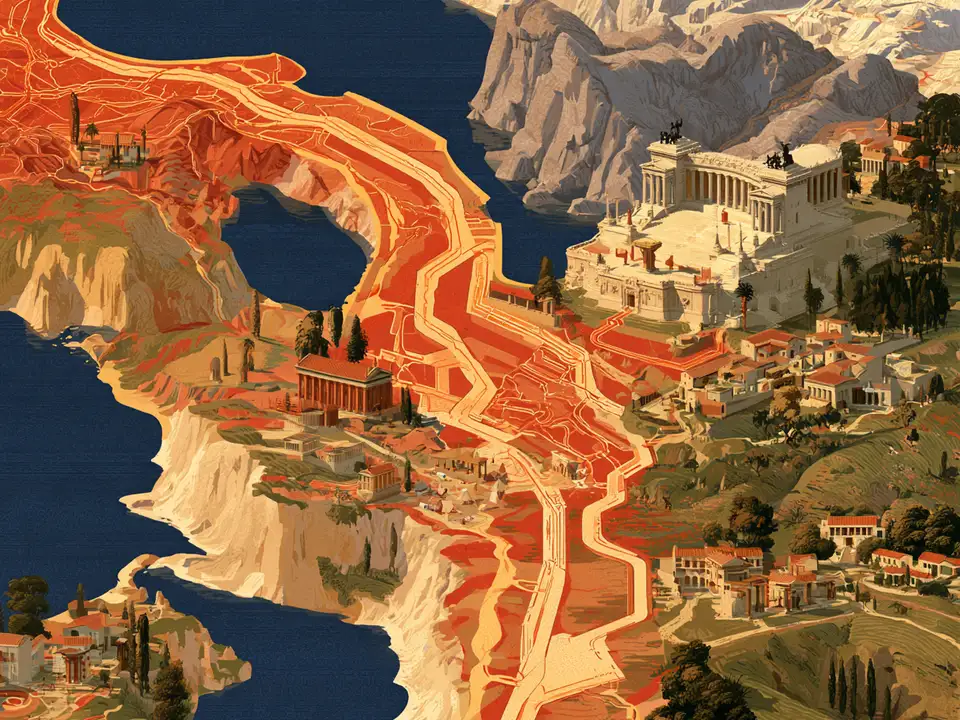
In his new volume, classicist Tim Whitmarsh reads early Christian texts against the Roman world that cradled them. The Greek word hodos, he notes, denotes a literal road as well as a spiritual path, and the apostles trod the empire's highways. Whitmarsh argues the faith spread through imperial roads, tongues and swirling traffic, not by miracle alone, and weighs whether the religion was truly revolutionary.
PHILOLOGIST TRACES CHRISTIAN “WAY” TO ROMAN ROADS, FINDS FAITH BUILT ON BORROWED PIECES
A classical scholar’s new volume argues the early followers of Jesus moved along the empire’s highways—and that the faith itself was assembled from goods already swirling through the Roman world.
Tim Whitmarsh, a classicist, takes up the question in his new book, “Rome’s Age of Revolution: Augustus, Empire and the Making of Christianity.” Returning to the original Greek, he notes that hodos—the word underpinning the idea of “the Way”—may mean a spiritual path but more often means a physical road, or a journey along one. Paul and the early missionaries, he argues, were on a spiritual journey and also on what Whitmarsh calls a literal road trip across modern-day Turkey, Syria, Greece and elsewhere, traveling a network of roads dramatically reorganized and extended under Augustus.
The book asks how revolutionary the religion really was by situating its original texts in the Roman Empire and the cultures it encompassed. Whitmarsh does not argue against Christian belief, this reader observes, but against Christian uniqueness, wielding philology rather than polemic. Much of what seems distinctive in the Christian narrative, he shows, stems from cultural tropes already circulating in the empire—and the faith spread along the infrastructure the empire provided. If roads, languages and constant movement made Christianity possible, the argument runs, it was the empire, not the new religion, that remade the world.
He develops this through two concepts. The first he calls “swirl”—the unprecedented movement of people, goods and ideas across the empire, allowing a religion drawing on Jewish, Greek and Roman culture to flourish. The second, “paradox,” holds that the Roman order, stretched across vast territories, tended to provoke its opposite, as in the birth of Christianity. This reader finds Whitmarsh at his best on swirl, his grip on ancient languages taking him back to original sources.
Roughly two thousand years ago, a biographer told of a boy whose birth was preceded by a portent announcing nature pregnant with a king, after which the city’s leaders, fearful of losing power, ordered all new male offspring killed. The account reads like the slaughter of the innocents ordered by Herod—but it comes not from the Gospels but from Suetonius, and the boy was Augustus. Virgil’s Fourth Eclogue, composed around 40 BCE, prophesies a golden age ushered in by the birth of a boy, arriving when virgo returns. Whitmarsh proposes no