On the 250th anniversary of American independence, this address reframes the narrative of American exceptionalism by highlighting New York City's history as a battleground for freedom, immigration, and civil rights. It argues that the true measure of the nation lies not in its concentrated wealth or power, but in the enduring struggle of ordinary citizens, immigrants, and marginalized communities to realize the founding promise of equality. Ultimately, the speech redefines patriotism as active, righteous dissent and community solidarity in the face of systemic injustice.
**THE DAILY INQUIRER**
*Late City Edition – Five Cents*
***
# 250 YEARS OF THE AMERICAN SHOW!
### GOTHAM CELEBRATES TWO AND A HALF CENTURIES OF THE GRAND EXPERIMENT!
#### From Washington’s Inkwell to the Hustle of the Modern Asphalt, New York Rescues the Promise of Liberty from the Fat-Cats and Nativists!
***
**BY A SPECIAL CORRESPONDENT**
**NEW YORK, July 3** — Since the dawn of time, the restless tides of Gotham’s harbor have whispered of destiny. Long before the white man’s tongue ever rattled these shores, the Lenape paddled their dugouts through the swells. Upon these very waters, the tall masts of Verrazzano and Hudson crested the horizon, leaving names now emblazoned on our mighty bridges and rushing rivers.
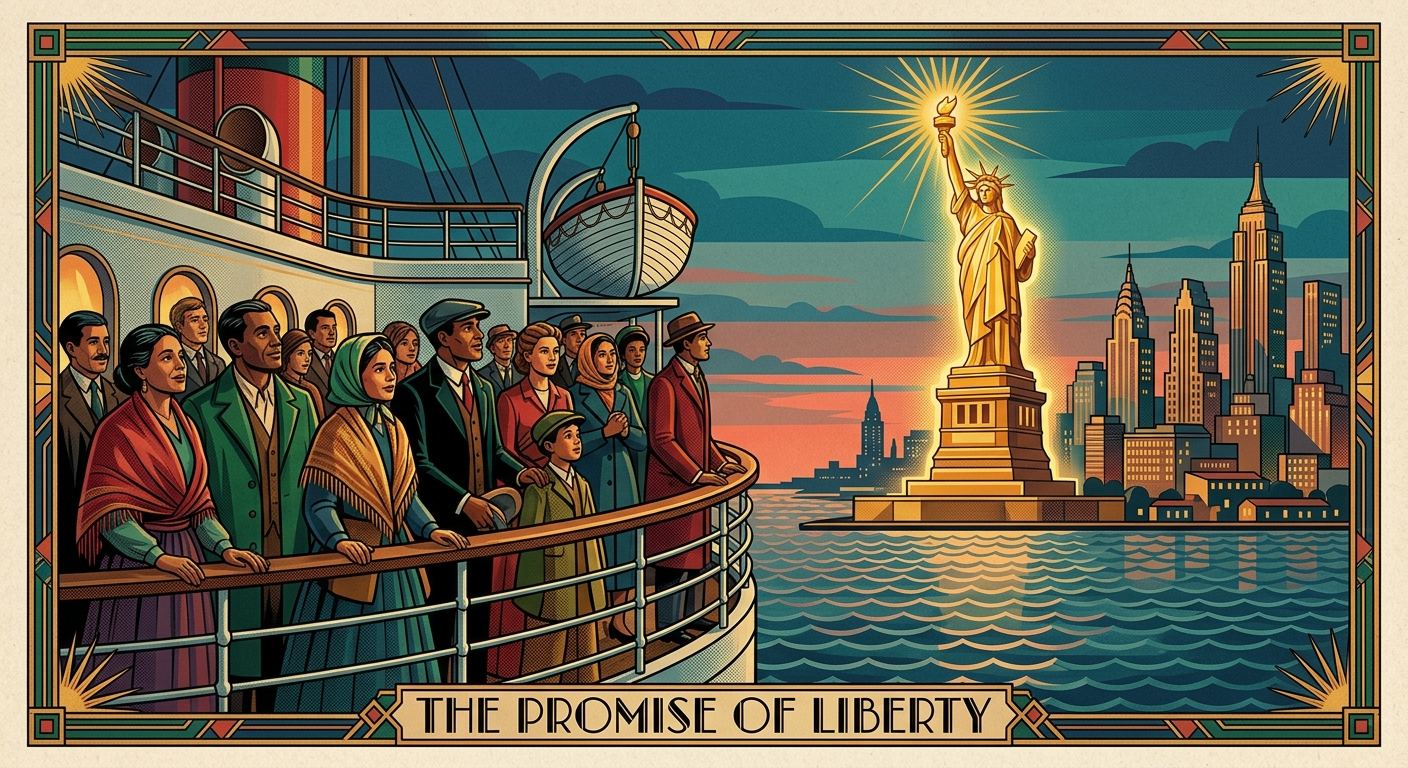
For generations, steamers packed to the gills with weary travelers have slipped through the Narrows, Atlantic gales howling at their backs.
And what did those tired souls see when they finally raised their eyes to the horizon?
They saw a land teeming with raw, green life. They saw the grim specter of the docks, where men once waited to sell their fellow man into chains. They saw the squalor of the tenements, the roaring, smoke-belching engines of industry, and a metropolis on the absolute hum. Finally, they saw her—the grand bronze Lady of Liberty, hoisting her torch to give the whole wide world a swell welcome.
They saw New York. They saw America!
***
### A HIGH-FLYING WINGDING FOR THE REPUBLIC!
Tomorrow, this grand Republic marks 250 years since the boys in Philadelphia signed our deed of independence. Two and a half centuries of an audacious experiment in self-governance—a scheme so wild that back in ’76, the smart-money cynics bet it wouldn’t last five years, let alone a quarter-millennium!
From the green pastures of Lexington to the moving-picture studios of Los Angeles, from the historic streets of Selma to the bustling neighborhoods of Midwood, Americans are gearing up for a first-class wingding. Families will gather around the backyard grill, and sky-rockets will paint the night sky in red, white, and blue.
But hold your horses, folks—this ain’t no ordinary Tuesday. Two hundred and fifty years is a rare spot of time for 340 million of us to look each other square in the eye and ask: *What is the soul of this nation?*
Sitting here at City Hall, behind the very wooden desk where General George Washington penned his dispatches, surrounded by fresh-faced greenhorns who just took their citizenship oaths, this writer can’t see the whole map. But like the millions who came before, I can see New York.
***
### THE NIGHT GOTHAM SAVED THE U.S.A.
The city we see today is a far cry from the one that greeted General Washington. In the sweltering July of 1776, Gotham was under the thumb of British tyranny. Down in Philadelphia, eighty miles south, a plucky band of newspapermen, dirt-farmers, and buck privates put their John Hancocks on a paper declaring truths that seem plain as day now, but back then were pure dynamite.
John Bull didn't take it lying down.
By August, the redcoats launched a ferocious assault on Brooklyn. The cannons on Governor’s Island barked at the British warships anchored in the bay. We were outmanned, outgunned, and soundly licked. Our baby democracy looked ready for the undertaker.
But under the cover of a pitch-black night, with the moon hiding behind the clouds, thousands of our doughboys silently climbed into flatboats and slipped across the East River to Manhattan. The Continental Army survived to fight another day! Independence may have been written in Philly, but it was snatched from the jaws of death right here in New York!
Washington was the last man to leave the Brooklyn shore. As the sun peeked over the water, he looked out at the harbor and saw what so many have seen since—a clean slate, and a chance to start anew.
***
### FROM WEEKSVILLE TO THE EMERALD ISLE
But those chances aren’t handed out on a silver platter, pal. You’ve got to fight for ’em.
Take James Weeks in 1838. Just eleven years after New York put an end to the dirty business of slavery, this emancipated colored man decided to carve out his own destiny. He bought up land in Brooklyn, won himself the right to vote, and sold lots to other freedmen. When those travelers hit the docks, they knew they had a home waiting for them. Weeksville still stands today—a living, breathing testament to the fact that America is made by the people who build it.
Soon, the floodgates opened. Hundreds of thousands of Irishmen arrived, their bellies empty from a famine made by imperial cruelty. Chinese sailors set up shop in what we now call Chinatown. Millions more squeezed through the turnstiles of Ellis Island—Jews fleeing the bloody czar’s pogroms, Italians escaping the poorhouse, and Syrians looking for a square deal.
They looked through the portholes at a city growing faster than a beanstalk. They saw merchants barking on the docks and skyscrapers punching into the clouds. Sure, they couldn't yet see the high-hat nativists who would deny them jobs, the greedy landlords who’d lock them out, or the sweatshops that would claim their daughters’ lives. But despite the smog, they saw a golden opportunity.
That burning desire didn't die out. It drove the Great Migration of colored folks up from the South, brought Puerto Ricans here after the Great War, and drew folks from the West Indies and South Asia.
Why, my own folks arrived on a roaring flying machine when I was knee-high to a grasshopper—just seven years old! Looking down from the aeroplane window, we saw Lady Liberty, and we saw the beautiful, patriotic work of making America live up to its promise.
***
### THE NONSENSE OF THE "EXCEPTIONAL"
The high-and-mighty love to chin-wag about "American Exceptionalism." The high-hat crowd says our wealth makes us better, that our bankrolls are thicker, and our muscle is stronger.
What a load of baloney!
The real story of America was written by the folks who were told they were nothing. It was built by the outcasts, the Puritans, the Quakers, the Muslims, and the Jews who were kicked out of their homelands for praying the wrong way. It was built by peasants from European slums who barely owned the shirts on their backs.
The truth is, America is exceptional because nothing here is set in plaster. The frontier may be closed, and we may have even walked on the moon, but the job of perfecting our Union belongs to every single stiff on the street—including the new Americans standing with me today.
The bosses and the big cheeses have always had their own answer. To them, America is a private club where only the select few get a square deal. They tell us the country belongs only to those with the right accent or the right shade of skin, and that the rest of us should just be glad we’re allowed to visit.
How small they are! How weak!
***
### CONTRADICTIONS IN THE GOTHAM STREETS
As we mark 250 years, what do we see?
We see a city of wild contrasts. We see the richest country in the history of the world, where hungry kids go to sleep while the world’s first trillionaire hungers for more. We see fat-cat trusts buying up elections.
We see masked federal flatfeet terrorizing our blocks, snatching our undocumented neighbors in unmarked vans. We see a nation whose immense wealth was built by those with calloused, dirt-streaked hands, while the real gravy goes to the soft-palmed coupon-clippers.
We see the health insurance racket squeezing the sick, and heartless slumlords letting tenements rot.
But that ain't all we see.
We see the nurse working a double shift, then stopping by to check on a sick neighbor. We see the honest working stiff tucking his kids under a leaky ceiling, still believing his family can get a square deal. We see neighbors linking arms to stop the immigration coppers from tearing families apart.
Some folks yell, "Love it or leave it!"
That’s just bunk. True patriotism isn't about saluting like a dummy; it's about raising a ruckus when things ain't right! It is precisely because we love this country that we refuse to leave it to the fat-cats!
***
### REMEMBER THE NINTH OF JULY!
Tomorrow is the Fourth, but this writer is thinking about the Ninth of July, 1776.
Five days after the big paper was signed, it arrived in Gotham. A hundred British dreadnoughts were bristling with cannons just off Staten Island.
Washington gathered his ragtag troops right here at the Commons—what we now call City Hall Park. With enemy guns practically sniffing their lapels, he ordered the Declaration of Independence read out loud. He told the people of New York that freedom was within their grasp.
That night, the citizens marched down to Bowling Green, tore down the lead statue of King George III, and melted that royal highness down into bullets for our boys' rifles!
Those ideals are strong enough to lick any tyrant, but only if we’ve got the moxie to fight for them.
What a swell privilege we have to shape this grand country. What a responsibility to prove ourselves worthy of the giants who came before. Let's get to work, folks, and make this country the place it was always meant to be.
***
*God Bless the U.S.A., God Bless New York, and have yourselves a roaring Fourth!*