The motion-picture director Masao Adachi, now aged eighty-seven, persists in his radical craft despite a turbulent past. Once a member of the Japanese Red Army and long resident abroad, he was jailed in 1997 for passport violations and is now barred from leaving Japan. His recent pictures, treating political militants, screen at festivals abroad. Adachi avows he will continue to revolt through cinema.
PARIS. The French-Swiss film director Jean-Luc Godard has died at the age of ninety-one. The obituaries celebrated his boundless cinematic inventiveness and the radical politics that shaped his work. To some, his passing marked the end of an era of politically committed filmmaking. But in Japan, another artist, every bit as radical, is still hard at work at the age of eighty-seven.
In the last four years alone, Masao Adachi has released two movies, both dealing with political militants (including Shinzo Abe's assassin). He has also worked with other artists, like the French filmmakers Éric Baudelaire and Philippe Grandrieux in the early 2010s. His most recent collaboration is with the Palestinian filmmaker Kamal Aljafari, whose new short film, "Masao Adachi Takes a Passport Photo," chronicles Adachi's latest attempt to apply for a passport. It screened at the Toronto International Film Festival and will play at the New York Film Festival this autumn.
As Adachi told the New York Times in 2012, he is pleased that these new endeavors do more than just burnish his reputation as an elder statesman of the Japanese New Wave. "Through this way," he said, "I'll continue to revolt."
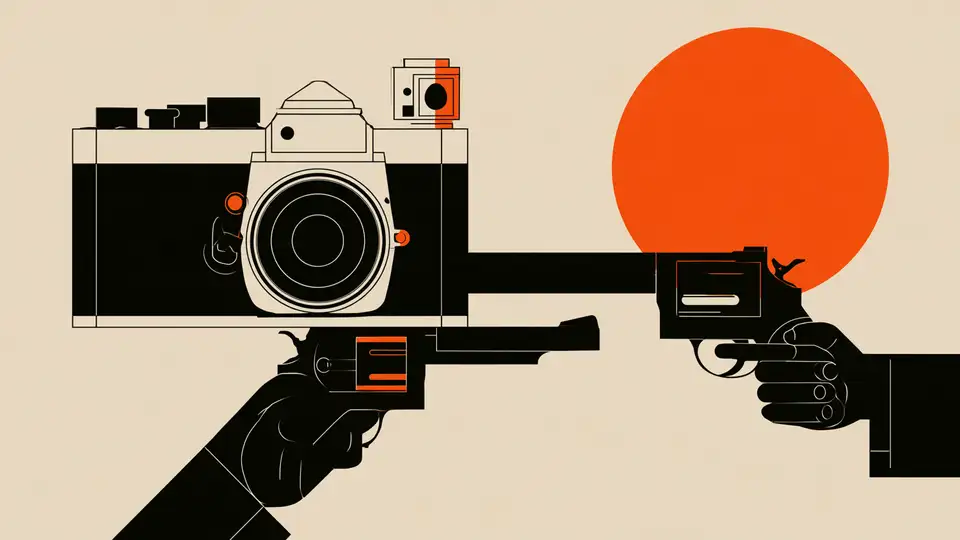
In his 1970 manifesto "What Is to Be Done?" Godard argued for the need not to make political films but to make films politically, since the former is idealistic and bourgeois, while the latter is militant and belongs to the Marxist and dialectical conception of the world. In 1971, Adachi responded to Godard's text with his own tract that asserted undo (movement, activism) over seiji (politics), arguing that drawing binary distinctions between political films and political filmmaking was counterproductive when a collaborative and dynamic undo-centered modality of cine-politics could encapsulate both concepts and more.
It has long been a cliché to discuss Adachi's work as standing at the intersection of politics and art, but what is particularly compelling in this regard is how the trajectory of his own life has embodied this intersection. In the 1970s, Adachi became directly involved in the Palestinian struggle and eventually relocated to the Middle East, where he was active as a member of the Japanese Red Army, a group that carried out hijackings and embassy attacks and claimed responsibility for the 1972 attack on Lod Airport in Israel that left nearly a hundred people dead or injured. Adachi, though, has always maintained that he was never involved in any attack on