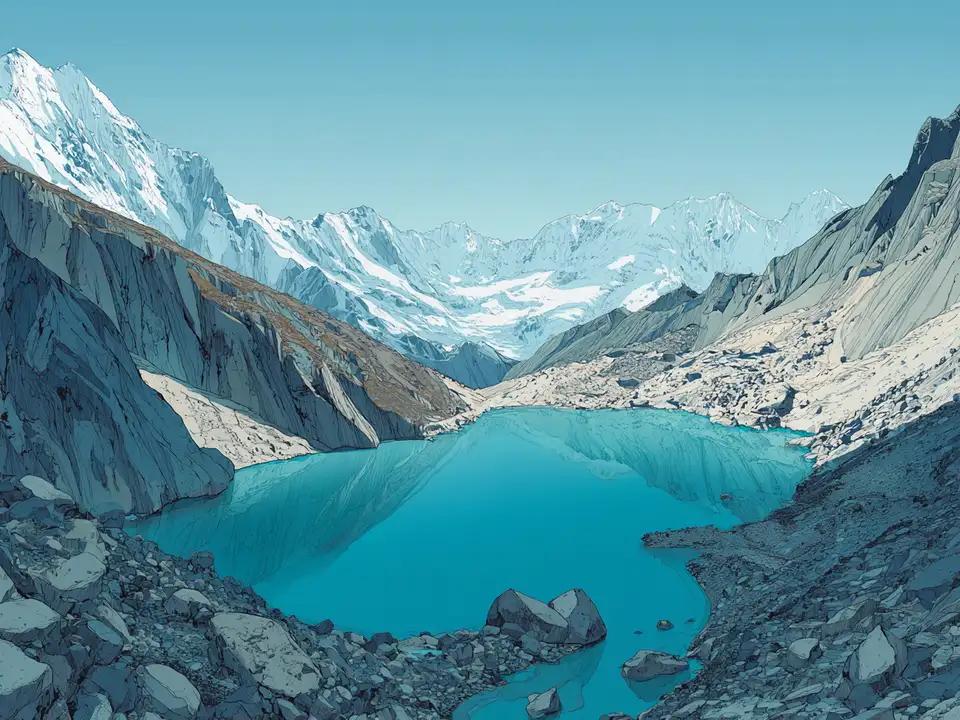
Arjun Karki, a Nepal lawmaker and former envoy to Washington, told the climate summit at Antalya, Turkey, that August floods in his mountain country left nearly 7,000 dead or missing. The Loss and Damage Fund has pledged about $20 million against a government estimate of nearly $5 billion. He says the Global North must foot the bill, calling it a right, not charity.
Nearly 7,000 men, women and children, dead or missing. Whole mountain villages swept off the map in a single black rush of water. That was Nepal's August, when a Himalayan glacier let go and the flood came roaring down. And now the little Himalayan kingdom of the poor stands with its hat in its hand, and the rich world has dropped a few pennies in it.
At the world climate parley in Antalya, Turkey, the one they call COP31, a lawmaker from the stricken land sat down with Amy Goodman and told it straight. He is Arjun Karki, a member of Nepal's House of Representatives, and Nepal's ambassador to the United States from 2015 to 2021. He has sat at the tables in Washington. He knows who holds the purse.
THE MAN WHO HEARD IT, NOT SAW IT
Mr. Karki was up in the high country near Makalu base camp, a peak 19 kilometer from Mount Everest, when the disaster struck. Mrs. Goodman asked what he saw.
"I didn't see anything. I heard this news, and I took a helicopter to come back to Kathmandu."
He walked the ruined ground the very next day.
Mr. Karki set the record straight on one point. It was no glacial lake that burst, he said, but melting permafrost, and that is why nobody saw it coming. "There was no rain, no flood, nothing. All of a sudden, it came."
47 POWDER KEGS ON THE ROOF OF THE WORLD
Worse is yet to come, if the warning bells go unheeded. The U.N. Development Programme and the Mountain Research Institute known as ICIMOD, in a study covering India, China and Nepal, name 47 potentially dangerous glacial lakes. Of the 47, a staggering 42 sit in Nepal. And the 42 lie in the very province that sent Mr. Karki to Parliament.
What is he doing about it? Hammering at the doors of his own government, he says, and demanding early-warning systems and a way to drain those lakes before they burst. The Bhotekoshi flood taught Nepal a bitter lesson: the folks living along the river corridors must be moved to safe ground. Most of Nepal's river basins are thickly settled, and a burst lake would catch them all, families who have lived there for years.
THE SMALLEST SINNER, THE BIGGEST BILL
Here is the rub, and Mr. Karki did not mince words. Nepal puts out less