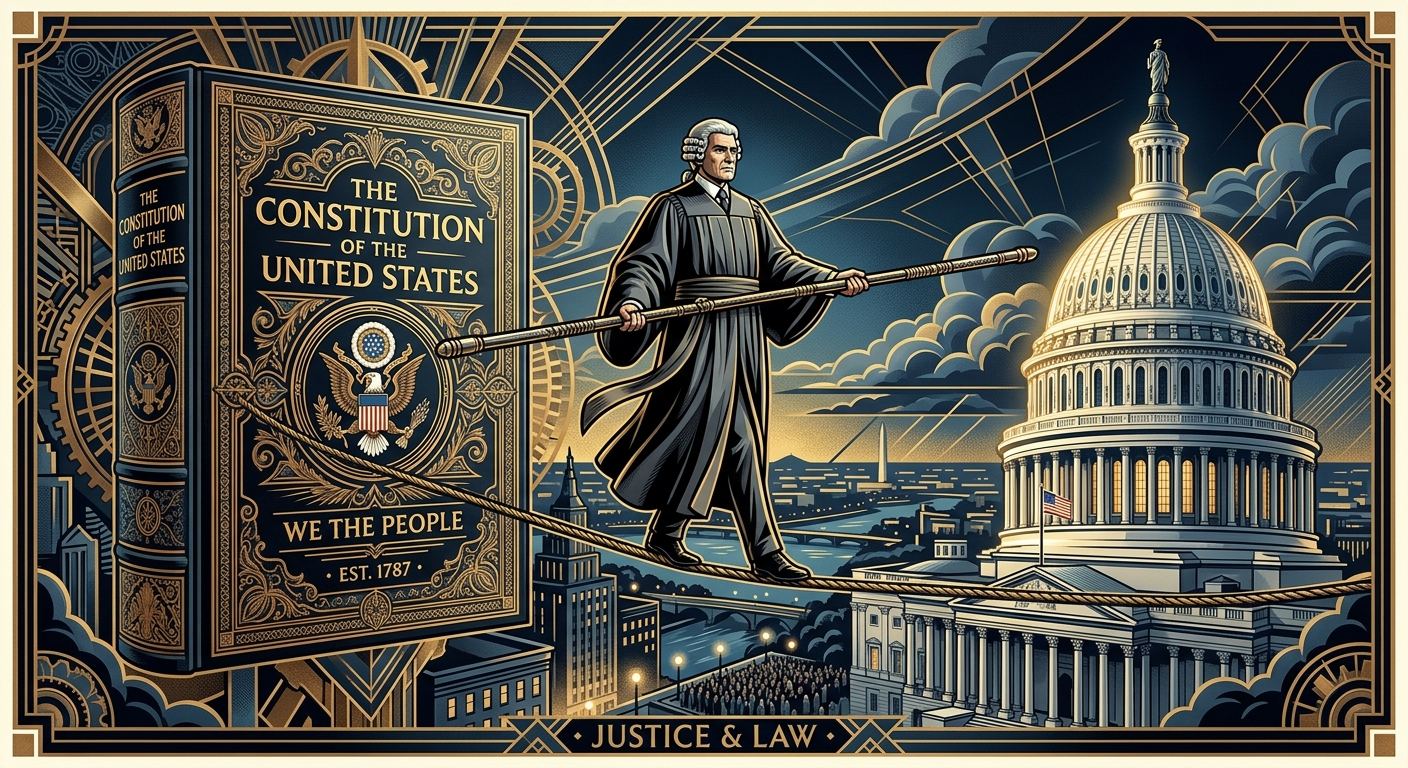
In the Supreme Court's ruling on Trump v. Barbara, Justice Brett Kavanaugh issued a highly unusual concurring opinion arguing that Donald Trump's executive order restricting birthright citizenship was constitutionally permissible but statutorily illegal under the Nationality Act of 1940. By suggesting that Congress has the power to carve out new exceptions to the Fourteenth Amendment's Citizenship Clause, Kavanaugh's seemingly moderate stance actually introduces a dangerous precedent that could reduce constitutional rights to mere legislative options. This position departs from traditional originalism and threatens the security of citizenship for all Americans.
**EXTRA! EXTRA! READ ALL ABOUT IT!**
**HIGH COURT SMASHES TRUMP CITIZENSHIP DECREE!**
*Nine Big Wigs Hand Down 194-Page Blockbuster on Who is a True-Blue American!*
*Justice Kavanaugh’s Ten-Page Tightrope Walk Decried as Pure Applesauce by Legal Scribes!*
**WASHINGTON, D.C.** — The telegraph wires are humming with the biggest courtroom drama since the Scopes trial! This week, the grandest tribunal in the land—the United States Supreme Court—dropped a paperweight of a ruling on the nation’s doorstep in the case of *Trump v. Barbara*. One hundred and ninety-four pages of legal high-hatting on the burning question: Who gets to be a citizen of Uncle Sam’s republic?
The big boss’s executive decree from last January—which instructed federal agents to deny the birthright of infants born to undocumented folks or short-stay visitors—has been dealt a staggering blow. But hold onto your straw boaters, folks, because the real shocker is a ten-page solo penned by Justice Brett Kavanaugh. It is a legal tango so strange, it’s got the whole town whispering!
While his brethren split into camps of grand principle, Kavanaugh walked a lonely, bizarre fence. He claims the President’s decree is perfectly swell under the Constitution, but illegal under a 1940 act of Congress! It’s a fast-talking play to look like a moderate, but legal eagles warn his logic is a dangerous banana skin that could slip up the rights of every citizen in the union.
To get the straight dope, we must look at how the Nine Big Wigs split on this high-stakes squabble:
---
### THE CHIEF’S CHORUS: THE FIVE-JUSTICE CONSENSUS
Chief Justice John Roberts, leading a five-man majority, sang a tune of old-school English common law. Roberts made it plain: the Fourteenth Amendment’s citizenship clause—“All persons born or naturalized in the United States, and subject to the jurisdiction thereof, are citizens”—was written to put the kibosh on the infamous *Dred Scott* business once and for all.
Roberts stood firm on the landmark 1898 case of *United States v. Wong Kim Ark*, which ruled that a lad born on San Francisco soil to Chinese parents was a true-blue American. Birthright is the bedrock, Roberts declared, and the President cannot dig it up.
---
### THE DOMICILE DUO AND THE LONE SKEPTIC
Two conservative heavyweights, Justices Clarence Thomas and Neil Gorsuch, took a different streetcar. They agreed *Wong Kim Ark* was correct but argued that a parent’s home address—their domicile—determines the child’s fate. They thought Trump’s order was perfectly fine to stop "birth tourists," but they weren't ready to shut the door on the children of long-term undocumented folks.
Meanwhile, Justice Samuel Alito played a lone hand. He argued that citizenship should only belong to those who owe "sole allegiance" to Uncle Sam, pointing back to the Civil Rights Act of 1866. Still, even Alito admitted *Wong Kim Ark* was decided correctly on its facts, because those Chinese parents had done everything in their power to establish a permanent home when the law forbade them from naturalizing.
---
### THE KAVANAUGH CONUNDRUM: MODERATE OR MADNESS?
And then, ladies and gents, we have Justice Kavanaugh. He voted with the majority to sink the President’s ship, but his reasoning? Oh, it’s a doozy!
Kavanaugh claimed the constitutional question was "far too complicated" and tried to dodge it. He pointed to the Nationality Act of 1940, which copied the Fourteenth Amendment’s text word-for-word. Kavanaugh claims that while the Constitution doesn't block Trump from narrowing birthright citizenship, this 1940 congressional statute does!
Now, if you think that sounds like a load of bunk, you’re on the right trolley. You can’t separate the statute from the Constitution when they use the exact same words! But Kavanaugh’s real twist is this: he claims Congress has the power to do what the President cannot. If Congress amends the Nationality Act to deny citizenship to these children, Kavanaugh says he’d give it the green light!
This is a wild departure from the "originalist" faith these jurists usually preach. Originalists say the Constitution’s meaning is fixed like cement. But Kavanaugh says the Court must adapt the document to "modern situations" the Framers never dreamed of.
Why, one could use that very same jazz to ban repeating rifles by claiming the Framers only knew of muskets!
---
### CITIZENSHIP ON the CHOPPING BLOCK
By transforming a sacred constitutional shield into a mere act of Congress, Kavanaugh’s wacky view would leave the citizenship of millions of Americans at the mercy of whatever political wind blows through Washington.
The gossip around the water cooler is that Kavanaugh wanted to side with Alito’s hardline view but feared the public would give him the raspberry. In trying to look like a middle-of-the-road swell, he fell backward into a radical position that makes citizenship a cheap political football.
In a final footnote, Kavanaugh assures us that "nothing in this opinion is intended to suggest how birthright citizenship should be addressed as a policy matter."
Sure, Brett—and there’s only ginger ale in those teacups down at the local speakeasy!