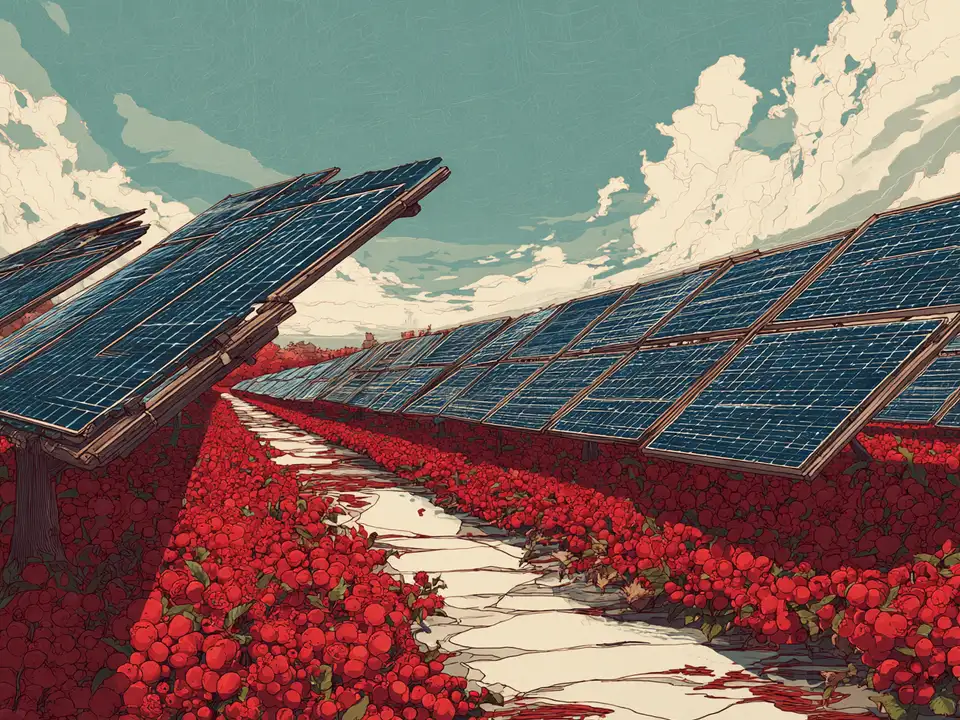
Two Massachusetts cranberry bogs have gathered their second harvest beneath working solar arrays, a novel union of husbandry and electric power. State inducements encourage such double-duty acreage, while special foundations and overhead wiring meet the bogs’ peculiar demands. The Kingston and Plymouth ventures have prompted further projects; separate, unfinished installations in Carver may yet be completed.
Today.
The cranberry harvest has taken a novel turn at two farms in this region, where pickers steer their equipment about metal poles beneath the shade of solar panels. Elsewhere in the bogs, growers gather the ruby-red berries bound for holiday cakes, juice bottles, and cans of jellied sauce. Here, the sun is doing double duty.
The two bogs are the first in the country, perhaps the world, to grow cranberries beneath an operating solar installation. This fall marks the second season of harvesting berries from under the panels.
“We are literally proving it can be done,” said Prateek Tare, co-founder and executive vice president of Distributed Energy Infrastructure. His concern constructed both projects: a 4.4-megawatt array paired with a 13.5-megawatt-hour battery in Kingston, and a 1-MW solar array in neighboring Plymouth.
Solar development figures prominently in Massachusetts’ plan to reach net-zero carbon emissions by 2050. The state has offered solar incentives since 2001, revising and expanding them over the decades to spur development.
But where to put the panels? That question has stirred considerable contention in a state thick with people and woodland. Rooftops and parking lots in developed districts can mean higher costs and limited generating capacity. Proposals for arrays on previously undeveloped land often draw protests from residents concerned about their communities’ character and environmental groups opposed to disturbing ecosystems.
Already-cleared farmland offers possibilities, but also raises the worry that agricultural acres will be taken out of production. Much the same predicament confronts communities across the US.
Massachusetts has been encouraging an arrangement called agrivoltaics, or dual-use solar: panels erected above working agricultural operations. The scheme, gaining ground nationwide, permits land to generate electricity while livestock graze or crops grow beneath the elevated arrays.
In 2018, Massachusetts became the first state to offer a financial boost to such projects. Its solar incentive program pays participants a set rate for every kilowatt-hour generated. An array with a capacity between 1 MW and 5 MW currently receives a base rate of 23.17 cents. Agrivoltaic projects collect an extra 9 cents per kilowatt-hour.
That can be sufficient inducement for developers to lease land for arrays or, less commonly, purchase property outright under an agreement to keep it in agricultural use. Farmers who lease generally receive payment as well for tending the landscape around the panels and poles.
In Kingston and Plymouth, clean energy developer Greenbacker Renewables bought land that had